Stinging insect pressure accelerates rapidly across Central Oklahoma from late May through September, driven by prolonged heat indexes and fluctuating prairie winds. BugHaven Exterminators approaches colony elimination…
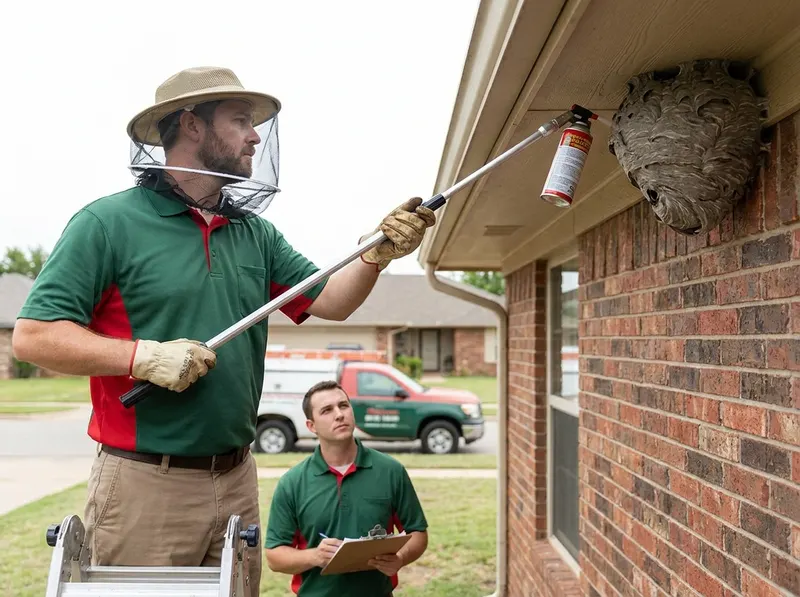
Stinging insect pressure accelerates rapidly across Central Oklahoma from late May through September, driven by prolonged heat indexes and fluctuating prairie winds. BugHaven Exterminators approaches colony elimination through methodical structural defense rather than generic chemical saturation. Exterior nests under soffits in neighborhoods like Heritage Hills, Crown Heights, and Mesta Park are systematically identified, neutralized using focused knockdown agents, and scraped down to eliminate residual pheromone markings. Chemical exposure indoors is mitigated because treatments target exterior nesting substrates without off-gassing into interior living areas. By relying on the structural guidelines of the EPA Integrated Pest Management principles, treatments directly protect human occupants while neutralizing structural nesting risks. Technicians use dedicated equipment adhering to OSHA personal protective equipment standards to execute extractions without dispersing agitated insects into nearby yards.
Ground-nesting yellowjackets and aerial bald-faced hornets present distinct risk profiles across diverse suburban layouts. In high-density settings like the Plaza District, Deep Deuce, and Gatewood, yellowjackets routinely establish colonies in subterranean rodent burrows or along retaining walls, requiring pressurized dust penetration directly into the brood chambers. Subterranean nests warrant targeted formulation delivery registered through the Oklahoma Department of Agriculture, Food and Forestry to prevent groundwater runoff near municipal drainage routes. Conversely, established properties in Nichols Hills, The Village, and Quail Creek frequently host expansive bald-faced hornet paper nests suspended 15 to 30 feet high in mature oak canopies, requiring mechanical pole scrapers and perimeter containment. Guidance from the Oklahoma State University Extension confirms that paper wasps construct communal brood combs using chewed wood fibers, leaving chemical trail markers that attract future queens to identical eaves if the anchoring surface is not treated.
Eradication protocols follow an exact operational sequence to protect building occupants. First, technicians map flight trajectories to locate the primary brood entrance, separating aerial nests from void infestations concealed within wall cavities or attics. Second, pressurized non-repellent agents or freezing formulations derived from NIOSH outdoor worker safety field procedures neutralize stinging workers instantly to stop defensive swarming. Third, the colony envelope is detached and enclosed in containment bags for disposal. Fourth, technicians apply a long-lasting micro-encapsulated barrier containing synthetic pyrethroids regulated under the structural pest management benchmarks to deter re-nesting queens. In lakeside microclimates near Lake Hefner and surrounding the trails of Scissortail Park, humidity drives rapid nest construction along covered patios; sealing localized brick veneer weep holes with copper mesh based on National Park Service biological control exclusion standards prevents aerial colonies from converting into internal wall-void nightmares.
When structural colonies penetrate underlying building materials near Chisholm Creek or outer commercial sectors, homeowners face a clear technical choice: standard superficial exterior spraying versus deep wall-void thermal tracking and direct injection. Surface aerosol applications simply aggravate hornets nesting behind siding, causing them to chew through interior drywall and enter bedrooms or hallways. BugHaven Exterminators isolates the active brood pocket using directional acoustic listening tools compliant with the National Pest Management Association guidelines, puncturing only precise injection ports into exterior sheathing to flood the central cavity. The trade-off centers on non-destructive mechanical intervention: topical spraying risks indoor structural breach, whereas surgical void treatment isolates the colony cleanly with minimal cosmetic repair. All operations reflect environmental guidance established by the U.S. Fish and Wildlife Service and the Entomological Society of America to target only aggressive social wasps without disrupting beneficial non-target pollinators.
Every job gets a firm, written price after a free on-site visit.
For standards, safe disposal, and service guidance on PEST CONTROL SEVICE in Oklahoma City, OK, useful references include U.S. EPA, ENERGY STAR, U.S. Dept. of Energy, Consumer.gov, U.S. Census Bureau, and Google Maps. General consumer and small-business resources are available from USA.gov, Better Business Bureau, FTC Consumer Advice, U.S. Small Business Administration, and Ready.gov.
Tell us about your wasp and hornet nest removal job in Oklahoma City and we'll send a clear, written quote, usually the same day.
 BugHaven Exterminators